The $399 Gamble: How a Card-Sized Device Redefined Music Before Smartphones Killed It
Two decades and a half ago, Apple bet its revival on a pocket-sized hard drive, challenging giants like Sony with a device that promised to hold a user's entire library in their pocket.
By Wei Zhang ·
The central tension of the 2001 launch was stark: a company recently rescued from the brink of irrelevance was attempting to dethrone established giants in a crowded market. While Sony and smaller firms like Creative and Sonic Blue already held portable music players, Apple CEO Steve Jobs argued that none had yet found the correct formula for digital music. The conflict lay in Apple’s decision to enter a space dominated by CD players, MP3 CD players, flash drives, and existing hard disk-based jukeboxes, betting that the last category was the optimal entry point for a new standard.
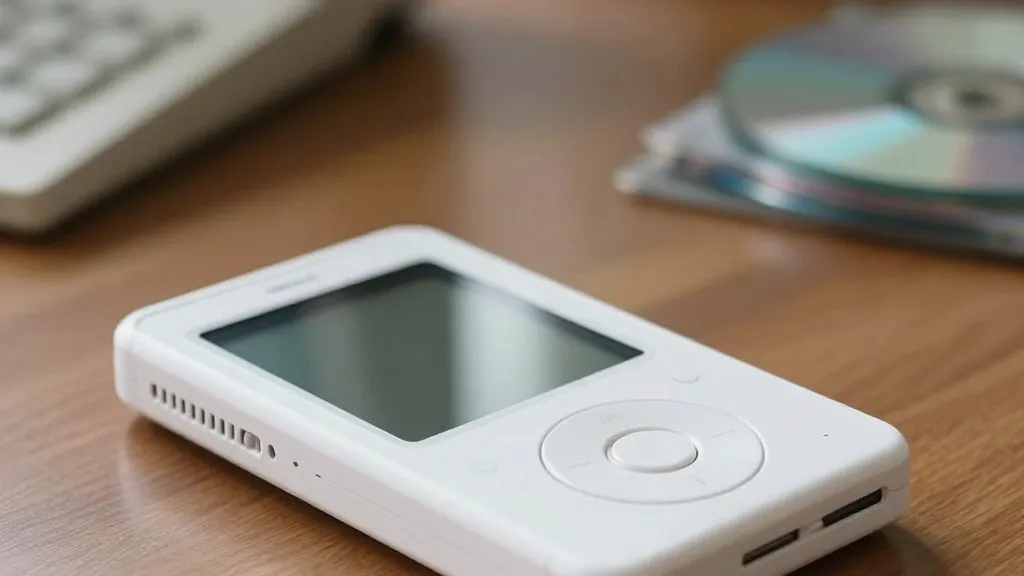
The device itself was a study in conflicting priorities: massive storage capacity crammed into a form factor smaller than a standard cell phone. By utilizing Toshiba’s then-new 1.8-inch hard drive, which was just 0.2 inches thick, Apple created a player measuring 2.4 by 4 by 0.78 inches and weighing only 6.5 ounces. This allowed the device to store 5GB of data, equating to 1,000 songs at 160Kbps. For the average consumer, this was marketed not just as storage, but as the entirety of their personal music library, a claim that was unprecedented at the time.
The technical execution relied heavily on proprietary connection speeds to justify the hardware. The original iPod was the first and only music player to feature a FireWire 400 connection. During the unveiling, Jobs claimed this allowed for a full CD of music to be transferred in five to 10 seconds, a stark contrast to the five minutes required for a single CD on contemporary USB connections. Filling the device with its full 1,000-song capacity was estimated to take just 10 minutes, compared to five hours on competing USB devices. The device also included a rechargeable lithium-polymer battery that provided 10 hours of playback and could reach 80% charge in one hour.
Beyond raw specifications, the experience was engineered for frictionless interaction. The device featured a piezoelectric clicker on its scroll wheel, providing tactile feedback for single-handed operation. This design allowed users to quickly navigate playlists, artists, or specific tracks. The launch was synchronized with the release of iTunes 2, which introduced an Auto-Sync feature. This ensured that any library curated on a Mac was automatically mirrored to the iPod whenever connected, effectively turning the portable player into an extension of the desktop computer rather than a standalone silo. The device also functioned as a FireWire hard disk drive, adding a utility layer beyond music.
The context of the launch was critical. Apple had successfully navigated the post-dot-com bubble slump, with the iMac and iBook lines stabilizing its fortunes. Jobs envisioned the Mac as the hub of a user’s digital lifestyle, connecting cameras, DVD players, and this new audio device. By positioning the iPod as the center of music consumption, Apple aimed to solidify its ecosystem. The first song demonstrated on stage was 'Building a Mystery' by Sarah MacLachlan, a choice that underscored the device's focus on mainstream pop accessibility rather than niche audiophile features.
The long-term outlook reveals the fragility of this dominance. Although the iPod sat alongside the iPhone for over a decade after the latter’s 2007 release, the smartphone inevitably rendered the dedicated music player obsolete. The product line continued through seven generations, with the final iPod Touch released in May 2019. While the line was left unmaintained for several years, it was officially discontinued in May 2022, marking the end of a 21-year era that began with a $399 price tag and a promise to put the world’s music in your pocket.
Source: Tom's Hardware